.png?width=198&height=27&name=logo%20(1).png "Abrasivestocks")
Secrets to Fast, Accurate Tube Sawing: Select the Right Saw Blade & Maintain It Properly
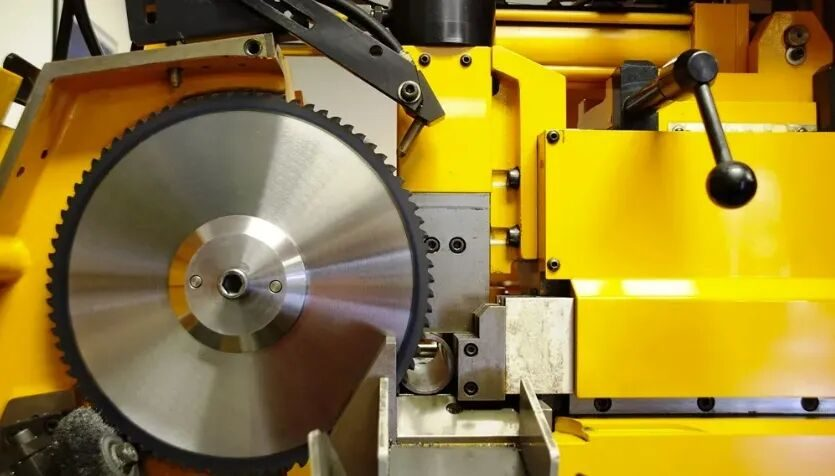
Table of Contents
In metalworking and structural component fabrication, tube and pipe sawing features unique dynamic cutting mechanics. Unlike solid bars or standard profiles, tubes undergo continuous shifts in cross-sectional geometry and contact area throughout the sawing cycle. Therefore, correctly matching band saw blades or circular cold saw blades by tooth count, substrate material and geometric parameters, paired with systematic process maintenance, is the core driver of superior cut quality, extended tool life and boosted production throughput. Image source: Scotchman
I. Kinematic Characteristics & Challenges of Tube Sawing
Geometric peculiarities of tube cross-sections introduce inherent instability during cutting, stemming from two key factors:
Continuously Variable Wall Thickness & Contact Surfaces
As the saw blade penetrates the tube, the effective wall thickness engaged by the cutter changes constantly. Within a single cutting pass, the number of engaged teeth, chip load per tooth, heat generation and vibration risk all fluctuate in real time.
Intermittent Cutting & Cyclic Impact Loads
Solid bars deliver consistent, continuous cutting engagement; by contrast, tube sawing subjects cutting teeth to repeated cycles of cut-in and cut-out. This intermittent cutting imposes severe periodic impact loads and vibration on tooth edges. Mismatched process parameters frequently result in tooth chipping or out-of-square skewed cuts.
II. Matching Saw Tooth Parameters to Tube Specifications
1. Correlation Between Tooth Count (Tooth Pitch) and Wall Thickness
Wall thickness is the primary variable for sizing band saw or circular saw blades, governed by the following core process rules:
· Thin-walled tubes: Fine-pitch blades with more teeth are mandatory. At all cutting stages, a minimum of 3–4 teeth (5–6 teeth for ultra-precision applications) must remain in contact with the workpiece to prevent individual teeth from catching thin tube walls and chipping.
· Thick-walled tubes: Coarse-pitch blades with fewer teeth are required. Heavy chip generation during thick-wall cutting demands ample gullet space for rapid chip evacuation, eliminating chip clogging and workpiece adhesion on tool edges.
2. Application of Variable Pitch Blades
For band sawing, variable-pitch band saw blades (blending alternating tooth pitches and heights within a repeating cycle) effectively suppress resonant vibration in tube cutting. Variable pitch breaks consistent harmonic vibration cycles, evenly distributes cutting forces, and drastically reduces chatter for flatter, cleaner cut surfaces.
3. Special Considerations for Angular Miter Cuts
When cutting tubes at an angle (e.g., mitered elbows), the equivalent wall thickness encountered by the blade rises sharply. Blade selection here becomes a balancing act: the pitch must be coarse enough to accommodate large chip volumes generated at the top and bottom cutting zones, yet fine enough to avoid tooth jamming during wall transition. For such applications, power downfeed systems with automatic closed-loop control deliver constant feed pressure and greatly mitigate tooth fracture risks.
III. Matching Tool Substrate to Workpiece Metallurgy
Metallurgical properties of metal tubes dictate optimal blade substrate and coating selections. Standard matching schemes for common materials are outlined below:
1. Carbon Steel (Mild & Medium Carbon Steel)
Carbon steel exhibits favorable machinability.
· Band sawing: Bimetal band saw blades with positive rake angles and variable pitch deliver balanced service life and cutting efficiency.
· Circular cold sawing: High-speed steel (HSS) blades are standard; cermet-tipped blades are specified when superior surface finish is prioritized.
2. Stainless Steel
Stainless steel features exceptional hot hardness and severe work-hardening tendencies.
Critical process guidelines
Cutting teeth must remain razor-sharp, with aggressive, deep cutting action strictly enforced. Any sliding or rubbing contact between dull teeth and the workpiece instantly accelerates surface hardening and renders the tool unusable.
Tool selection
Blades with large positive rake angles are required, paired with calibrated feed rates and PVD coatings (e.g., titanium nitride TiN) to reduce workpiece adhesion and frictional heat buildup.
3. High-Nickel Alloys & Titanium Alloys
These aerospace and chemical-grade specialty alloys are difficult-to-machine and highly heat-sensitive.
Tool selection
HSS blades wear rapidly when processing these materials; carbide-tipped band saw and circular blades are mandatory. Sawing requires high-lubricity, high-cooling cutting fluids and an ultra-rigid feed drive system.
4. Aluminum Alloy
Aluminum features low density and soft substrate, yet high ductility that causes severe built-up edge (BUE) and gullet clogging.
Tool selection
Carbide or HSS blades with coarse pitch, oversized gullets and large positive rake angles are recommended, paired with flood coolant or minimum quantity lubrication (MQL) systems to prevent aluminum chip welding on cutting edges.
Process Note: The Myth of "Universal All-Purpose Blades"
No truly universal saw blade exists in industrial production. While compromise tooth counts can deliver limited compatibility across multiple materials (e.g., custom pitch calibrated for a 75% stainless steel / 25% carbon steel cutting mix), application-specific blades consistently outperform general-purpose alternatives in cutting speed, surface roughness and total service life. For high-volume manufacturing, maintaining 3–4 distinct blade tooth pitch sets for different tube wall and material grades is the scientifically proven strategy to lower costs and boost throughput.
IV. Saw Machine Rigidity, Blade Installation & Routine Maintenance
Premium saw blades alone cannot guarantee high-quality cuts; overall system rigidity and standardized operating protocols equally determine process performance.
1. Impacts of Mechanical Machine Condition
Worn guide blocks, loose spindles or degraded bearings induce lateral blade deflection and drift during cutting. Such mechanical instability negates the performance advantages of premium cutting tools and accelerates localized tooth fatigue failure.
2. Critical Overlooked Practices for Circular Cold Saw Blade Installation
Three installation details exert decisive influence over blade service life:
Flange Face Cleanliness
When replacing blades, residual metal micro-debris trapped between the flange and spindle face creates micron-level gaps. These gaps amplify runout at the blade outer diameter, causing lateral wobble at high rotational speeds and uneven premature wear.
Eliminate Installation Backlash
Drive pin holes on cold saw blades are slightly oversized relative to machine drive pins. Before torquing flange bolts, manually rotate the blade in its operational cutting direction to seat pin hole walls firmly against drive pins and eliminate positioning backlash. Skipping this step subjects the blade to instantaneous impact force upon initial workpiece contact, which may trigger catastrophic blade cracking.
Built-Up Edge & Residue Adhesion
Excessive cutting heat or insufficient lubrication causes micro metal particles to adhere to both sides of the blade. This accumulated residue builds over successive cuts, creating localized blade thickening and sudden cutting chatter or stuttering. Upon detecting this condition, halt production immediately for blade cleaning or resharpening.
V. Conclusion & Economic Performance Evaluation
When managing tube and pipe sawing operations, evaluating only raw tool procurement cost delivers misleading economic insights. Process engineers should adopt the technical economic metric of comprehensive cost per cut. Matching blade tooth pitch precisely to tube wall thickness and specifying application-tailored carbide or coated blades increases upfront tool expenditure, yet delivers measurable overall manufacturing cost reductions via faster cutting speeds, drastically extended tool life, fewer machine downtime intervals for blade changeovers, and reduced secondary machining workload (deburring, end-face finishing).