.png?width=198&height=27&name=logo%20(1).png "Abrasivestocks")
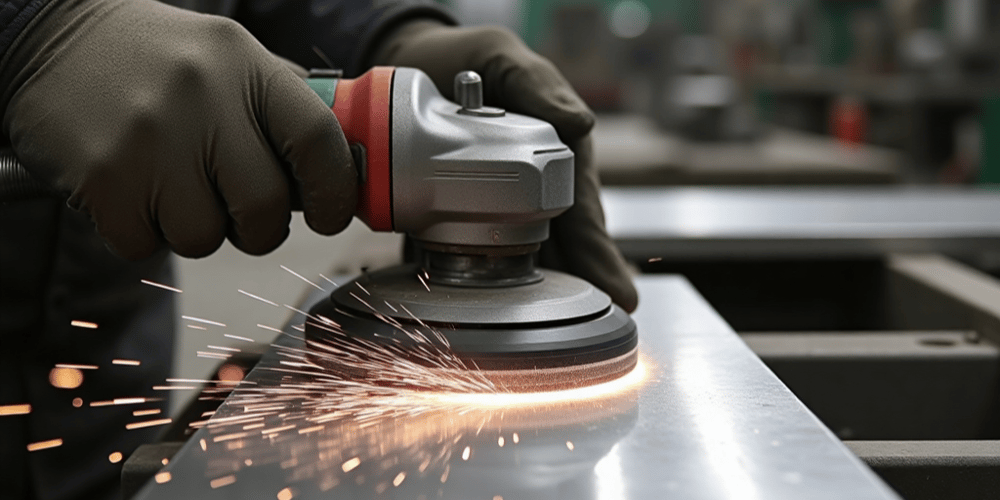
In many metal manufacturing enterprises, stainless steel workpieces typically go through cutting, bending, welding, and other processes before entering the most critical and experience-dependent stage—grinding and finishing. This step not only determines the product’s appearance quality, but also affects its corrosion resistance, hygiene rating, and even compliance with engineering safety standards. Once excessive bluing, stress concentration, surface contamination, or passivation failure occurs, the prior investment in materials and processing may be wasted.
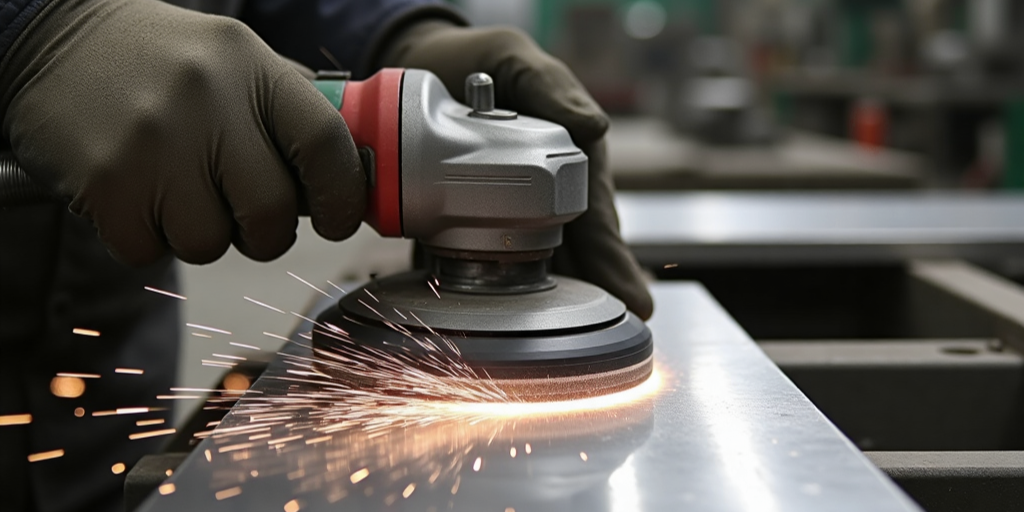
Compared with other metals, stainless steel is highly sensitive to heat. Some weld seams may appear acceptable on the surface, but if the operator applies excessive pressure or grinds for too long, local surface temperature rapidly increases, resulting in visible bluing. This not only affects appearance but may also alter the metal microstructure, affecting subsequent passivation and corrosion resistance. Since grinding and finishing are often performed manually, operator skill largely determines outcome, making heat control, contamination prevention, and consistency the core requirements.
In actual processing, grinding and finishing are continuous yet fundamentally different in purpose. Grinding is essentially material removal—such as weld height reduction, burr removal, or oxide layer stripping; finishing is surface texture formation, typically to meet client-specified texture grades, such as brushed or mirror surfaces on stainless steel. Because their goals differ, if overly deep scratches are left during grinding, the finishing stage will require excessive time and costly consumables to correct them, drastically reducing efficiency. In recent years, some manufacturers have optimized structural design to reduce weld height requiring removal, thereby improving finishing efficiency and reducing thermal risk.
To increase stainless steel grinding efficiency and minimize heat generation, several advanced abrasive technologies have become key. For example, ceramic abrasives exhibit continuous self-sharpening characteristics—the grains fracture while maintaining sharp cutting edges, allowing larger chips to be removed in a shorter time and reducing frictional heat. By contrast, aluminum oxide abrasives dull more easily, prolonging grinding time and generating more heat. Therefore, ceramic abrasives have become the mainstream choice for weld removal and shaping. However, high-performance abrasives alone do not ensure process stability—the grinder’s power and torque are equally important. If tool power is insufficient, discs cannot optimally fracture abrasive grains, prompting operators to instinctively increase pressure, further causing overheating, bluing, and even abrasive failure.
In recent years, more enterprises have adopted grinding equipment with current-monitoring functionality, providing real-time electrical feedback to guide proper applied pressure, making the process controllable and repeatable. Even without electronic monitoring, skilled technicians can assess pressure based on RPM change and spark behavior. For stainless steel, spark color is darker; a sudden reduction in sparks often indicates insufficient pressure or a heat-glazed disc. Grinding angle also directly affects heat generation and cutting efficiency. For example, standard flat flap discs typically operate at a 20°–30° angle, while conical flap discs expand the contact area due to their inclined geometry, making them suitable for both flat and curved surfaces and reducing localized heat concentration.
For curved tubing, irregular geometries, or thin-wall structures, grinding heat dissipation is more limited, and prolonged grinding on a single point can easily burn the material. Experienced technicians therefore keep the tool moving continuously, using long strokes along the weld rather than short back-and-forth “spot grinding,” to maintain more uniform temperature distribution. Additionally, for specific structures such as thin-wall stainless tubing, belt grinding tools with circumferential wrap-around contact help distribute pressure and avoid local deformation or “flat-spotting.”
Upon entering the finishing stage, the focus shifts from rapid material removal to scratch-size control. If overly coarse abrasives are selected initially (e.g., 40-grit), they may rapidly shape the surface but also introduce deep scratches that later require significant time and expensive consumables to eliminate. To minimize unnecessary cost, some enterprises now use dual-media interleaved wheels, which combine coated abrasives with surface-conditioning fibers to simultaneously remove material while producing a finer texture. At finer finishing levels, the use of non-woven materials becomes dominant, and these require speed-controlled tools. Excessive RPM can rapidly melt fibers, so they generally operate within the 3000–6000 rpm range, adjusted according to material and texture specifications.
For mirror finishing, operators commonly adopt a cross-grinding method, where each step is performed perpendicular to the previous direction, helping to identify and eliminate prior scratches quickly. Final mirror surfaces are typically achieved with felt tools and polishing compounds. In many factories, standard reference samples are preserved and displayed at finishing stations to ensure that operators across different shifts achieve consistent surface quality.
Following stainless steel welding, grinding, and finishing, another frequently overlooked yet essential step is passivation. Welding residue, carbon steel particles, or tool contaminants may inhibit the regeneration of the chromium oxide layer, leading to future corrosion issues. In recent years, more stringent industry requirements have promoted the wider adoption of electrochemical cleaning, especially in food equipment, pharmaceutical, and energy applications. To guarantee passivation quality, some factories perform cleaning both before and after finishing and document results with rapid test devices such as electrochemical potential measurement, enabling traceable quality records.
Because grinding and finishing are typically positioned near the end of the production chain, any errors incur extremely high rework cost. Therefore, a renewed examination of stainless steel grinding and finishing strategy can not only reduce rework, but eliminate process bottlenecks and improve throughput and consistency. With the introduction of advanced abrasive technologies, smart equipment, and process-control tools, stainless steel surface treatment is evolving from experience-driven craft to a controlled, repeatable scientific process—making complex surface finishing more stable and efficient.